Today is System Administrator Appreciation Day, and it is a good moment to explain what actually keeps your computers, networks and connections working reliably day after day. If you have never had to think about your backups, your firewall or a failed update, that is usually a sign that a system administrator has been doing their job well in the background.
SysAdmin Day is celebrated every year on the last Friday in July. It exists to recognise a profession that rarely gets noticed, but which keeps the gears of business turning. You can read more about its history at sysadminday.com. Below, I want to explain what the role really involves, why it matters to your business, and why I am proud of the team who do it here.
What a system administrator actually does
Most people picture IT support as someone who answers the phone when the internet stops working. That is part of it, but it is a small part of a much bigger picture. A system administrator looks after the daily running of your computers and networks, and a great deal of that work happens where you never see it.
The visible work
This is the part you notice, usually because something has gone wrong or you need help.
- Restoring an internet connection that has dropped
- Configuring and checking firewalls so the right traffic gets through and the wrong traffic does not
- Answering dozens of calls and support tickets a day, each one a real operational problem for the person raising it
- Sorting out access, accounts, email and the everyday tools your team relies on
When you contact a fast helpdesk and get a clear answer, that is a person who has learned your systems, understood your problem and fixed it under time pressure. It is skilled work, and it is often done while several other issues are competing for attention.
The invisible work
This is the part that keeps small problems from becoming large ones, and it is easy to overlook precisely because it works.
- Patching machines and updating networks so known security holes are closed
- Running security scans and watching for anything unusual
- Checking backups, spotting when one has failed and putting it right before anyone needs to restore
- Clearing down storage before a disk fills up and takes a critical system offline
- Monitoring systems so faults are caught early, often before you notice them
None of this generates a thank you email, because when it goes well, nothing appears to happen. That is exactly the point. The quiet weeks are the result of a lot of unquiet effort.
Why this matters to your business
Every one of those background tasks maps directly onto a business risk. When they are neglected, the cost tends to arrive all at once and at the worst possible time.
Backups that actually work
A backup you have never tested is a hope, not a plan. Backups fail quietly for all sorts of reasons: a change to a system, a full drive, an expired credential. Someone needs to check them regularly and act when one fails. The value to you is business continuity. If the worst happens, you can recover, and you know how long it will take.
Security you can rely on
Most breaches exploit known weaknesses that a timely update would have closed. Patching, scanning and sensible firewall rules are not glamorous, but they are what stand between your business and a bad day. Secure systems are the product of consistent, unremarkable maintenance, repeated on schedule.
Monitoring and prevention
Monitoring turns "we found out when it broke" into "we dealt with it before you noticed." Watching disk space, checking that services are running and getting an alert when something drifts out of normal means problems get fixed while they are still small. Prevention is almost always cheaper and less disruptive than a rescue.
One point of contact under pressure
When something does go wrong, you do not want to be passed between suppliers while the clock runs. Having reliable support and one point of contact means someone who knows your setup takes ownership and stays with the problem until it is resolved. That is worth a great deal on a difficult morning.
The reality of the job
I want to be honest about what this work is like, because appreciation should be grounded in reality. It can be stressful. It is often complex. It is frequently demanding, especially when several urgent issues land at once and each one belongs to someone who needs it fixed now.
It is also genuinely rewarding. No two days are the same. One hour you are untangling a network issue, the next you are advising a business owner on a practical way to reduce risk, and the next you are helping someone who was completely stuck get back to work. The variety is real, the problem solving is satisfying, and the difference you make to people is immediate.
Good system administration is a blend of technical skill, calm judgement and a stubborn refusal to leave a problem half solved. It rewards people who care about doing the job properly, even when nobody is watching.
A thank you to our team
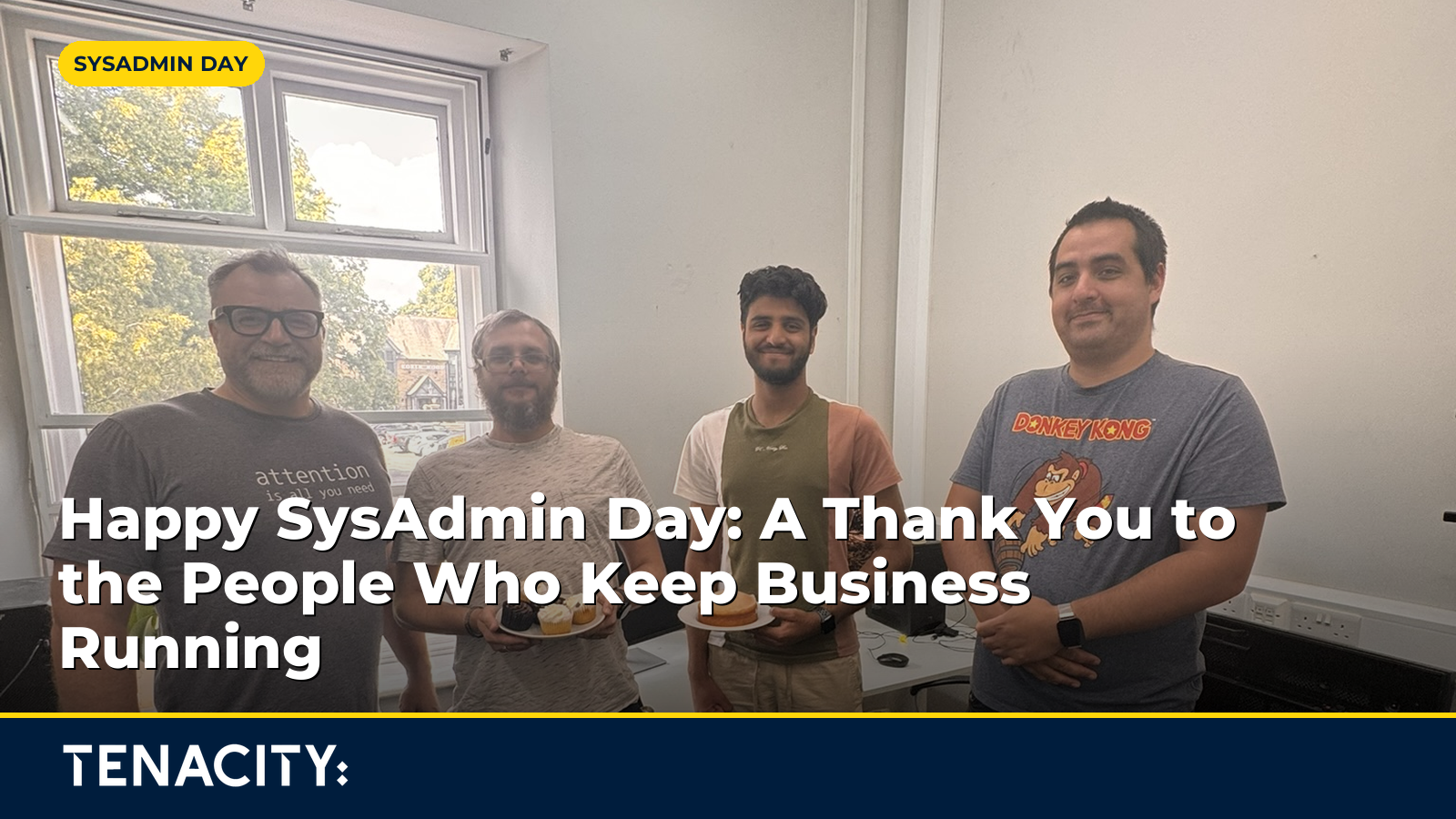
We celebrated today with a small cake and a moment to recognise the people who do this work. The photo shows just a small sample of the wider team, but the sentiment covers everyone.
So this is a genuine thank you from me. Thank you for the early starts and the late finishes, for the tickets closed and the disasters quietly prevented, for staying patient with people under pressure, and for the clear advice you give every day. The reliability our customers depend on is built by you, one careful job at a time.
The result for the businesses we support
For our customers, all of this adds up to something simple: systems that work, problems that get sorted, and a team you can actually reach when you need them. That is what dependable IT and telecoms support should feel like.
If your business is not getting that today, or if you are relying on hope rather than tested backups and active monitoring, let us take a proper look. Get in touch with Tenacity for a straightforward conversation about how we can keep your systems reliable, secure and well supported.